.webp)

Fertilize your Louisville cool-season lawn mainly in September through November, while the grass is actively growing. For tall fescue, Kentucky bluegrass, and perennial ryegrass, keep March–May lawn fertilization light and apply it only if your lawn needs it.
The calendar is a guide, not a four-application schedule. Before feeding, check soil moisture, lawn stress, soil-test results, and past applications. Pale grass or thin patches may need a better watering schedule, drainage, or mowing rather than fertilizer.
- Wait for growth and moisture: Skip frozen, snow-covered, saturated, or drought-stressed ground.
- Measure before spreading: Use your lawn’s square footage, product label, and soil-test guidance to set the amount.
- Finish with care: Spread evenly, avoid heavy rain, water as directed, and record each application.
Your lawn’s condition matters more than the date. Use the seasonal windows below to decide whether feeding makes sense.
Choose the Right Season to Fertilize
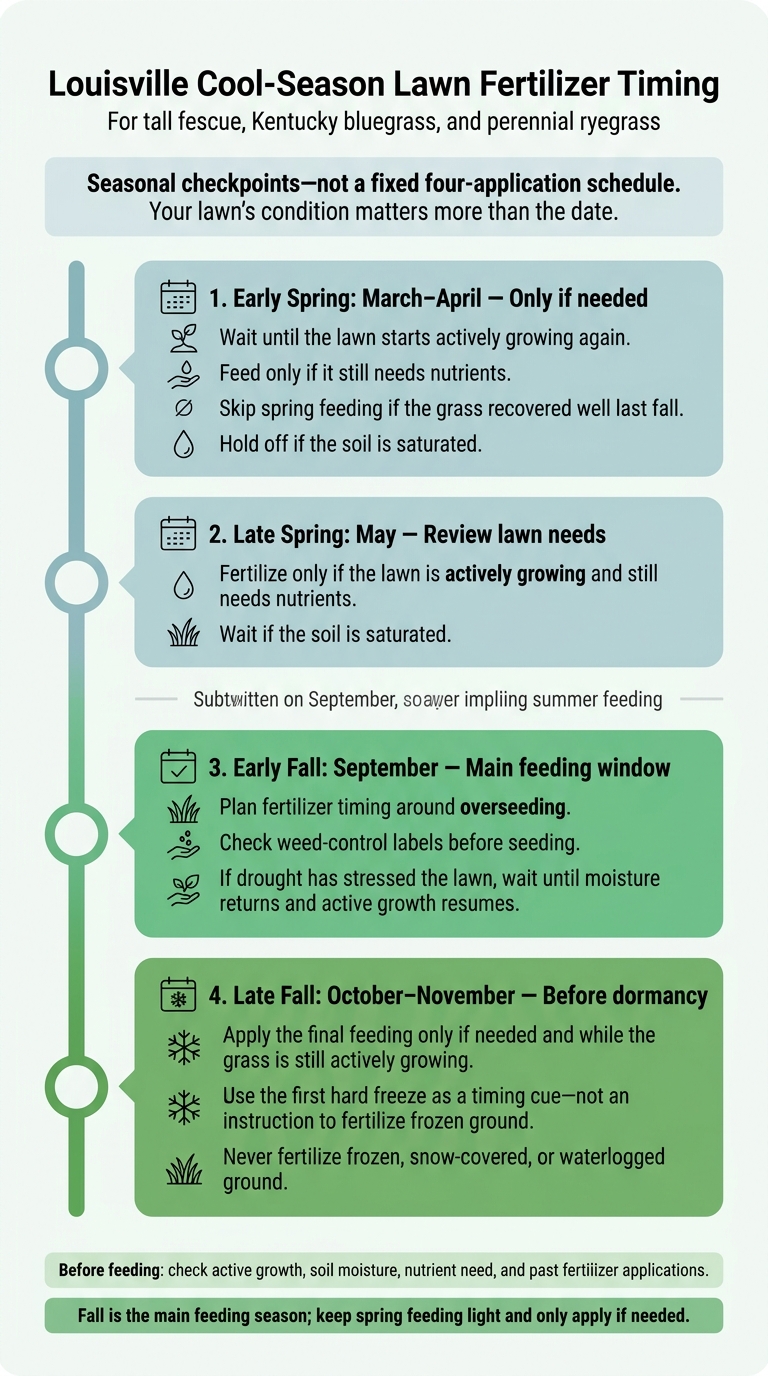
Louisville Cool-Season Lawn Fertilizer Timing
Treat these windows as checkpoints, not a fixed four-step schedule. Before feeding, check grass growth, soil moisture, and how much fertilizer the lawn has already received.
Early Spring: Fertilize in March–April Only if Needed
Wait until the lawn starts actively growing again. Feed only if it still needs nutrients, and skip spring feeding if the grass recovered well last fall. Hold off if the soil is saturated.
Late Spring: Review Lawn Needs Before Feeding in May
Fertilize in May only if the lawn is actively growing and still shows a need for nutrients. Wait if the soil is saturated.
Early Fall: Make September the Main Feeding Window
Plan fertilizer timing around overseeding, but check weed-control labels before seeding. If drought has stressed the lawn, wait until moisture returns and active growth resumes.
Late Fall: Fertilize in October–November Before Dormancy
Apply the final feeding while the grass is still actively growing. Use the first hard freeze as a timing cue, but never fertilize frozen, snow-covered, or waterlogged ground. Next, check whether the lawn needs fertilizer before you spread anything.
sbb-itb-1c58166
Check Whether Your Lawn Needs Fertilizer
Look at Grass Color, Density, and Recovery
Pale grass, thin spots, or weak growth don’t always mean your lawn needs fertilizer. Check watering, drainage, and mowing first.
Look at whether the problem affects the whole lawn or just a few patches. Patchy damage usually points to a local issue rather than low fertility. If the damage is patchy, inspect the soil before feeding. Review recent fertilizer applications, too, before adding more.
Check for Stress and Test the Soil
Start with soil moisture and drainage. Wet soil can look like a nutrient problem. Compaction, mowing mistakes, pests, and disease can also cause signs that resemble a nutrient deficiency. Rule these out before feeding - fertilizer won’t fix poor drainage or mowing problems.
Use a soil test to guide feeding, along with the lawn’s current conditions and past fertilizer applications. Once you’ve confirmed that the lawn needs fertilizer, use the test results and recent application history to choose the rate and decide whether to feed now.
Plan and Apply Lawn Fertilizer
Once you’ve confirmed your lawn needs fertilizer, identify your grass type and measure the area you’ll treat in square feet. Leave out driveways, garden beds, and walkways. Set the application rate, then calibrate your spreader for even coverage.
Calculate the Fertilizer Amount and Spread Evenly
Follow the product label and soil-test guidance to set the rate, taking recent applications into account. Calibrate the spreader for that product, measure the amount needed, and spread it evenly. Apply fertilizer only when the grass is actively growing and has enough moisture.
Water as Directed and Record Each Application
Don’t apply fertilizer before heavy rain or when the ground is saturated. After applying, water as directed. Record the product, rate, date, weather, and treated area so you don’t accidentally repeat an application.
Conclusion: Prioritize Fall Feeding and Check Lawn Conditions
For Louisville cool-season lawns, fall is the main feeding season, and a fall lawn care checklist shows where feeding fits among the other jobs that season. Feed in spring only if the lawn shows a clear need.
Before applying fertilizer, check soil moisture and look for signs of stress. Pale grass or bare patches often trace back to causes of a thinning lawn other than nutrients, so rule those out first. Skip feeding on wet ground.
If fertilizer is needed, use the rate on the label and spread it evenly. Time each feeding to the lawn’s condition, and treat the calendar as a guide. JTs Lawn and Landscaping provides seasonal lawn care across the Louisville area.
FAQs
What if I miss Louisville’s fall fertilizing window?
Missing Louisville’s early- to mid-fall fertilizing window doesn’t mean you’re out of options. You can still apply late-season fertilizer as long as the ground hasn’t frozen. If it has, wait until early spring to feed your lawn again.
For help with your lawn’s needs or to schedule professional care, contact JTs Lawn and Landscaping.
How soon after overseeding can I fertilize?
Apply a starter fertilizer when overseeding to give new grass the nutrients it needs. If you didn’t fertilize at seeding, wait until the grass has germinated and you’ve mowed it for the first time before applying a standard lawn fertilizer.
For help timing fertilizer applications for your Louisville lawn, contact JTs Lawn and Landscaping.
Where can I get my lawn soil tested in Louisville?
Contact your local University of Kentucky Cooperative Extension Service office for soil testing resources and guidance. The provided search results don’t identify specific lawn soil testing locations or services in Louisville, KY.
Related Blog Posts

How do I get started?

Request a quote — most companies do a free property assessment, walk you through recommended services, and can usually start within a week or two.
Do you take away the grass clippings?
Usually clippings are mulched back into the lawn, they return nutrients and are good for turf health. Bagging and removal is typically available on request or when growth is heavy.
Why does my lawn have brown patches?
Common causes include grubs or other pests, fungal disease, pet urine, drought stress, or mowing too short. Diagnosing the actual cause matters, because the treatments are completely different.
Are your products safe for kids and pets?
Most professional treatments are safe once dry, usually within a few hours of application. Your provider should tell you after each treatment how long to keep kids and pets off the lawn.
When should I fertilize my lawn?
It depends on your grass type and region, but most lawns benefit from feeding in early spring, late spring, and fall. A soil test or professional assessment tells you exactly what your lawn needs.

Book an Appointment
Reach out, we'll come look at your yard, and we'll tell you straight what it needs and what it costs. No pitch, no pressure.
We're a family business in Louisville, and most of our work comes from neighbors referring neighbors. That means you get the same crew every time and a price that won't change on you.
Grab a time that works. Let's take a look.
Request your free quote
We have received your estimate request and will be reaching out to you shortly.